ERPNext for manufacturing in India
Most small plants run production on paper and work out costing in a spreadsheet. ERPNext keeps the BOM, the shop floor and the accounts in one database, so your product cost comes from what actually happened on the floor.


Problem and fix
What usually goes wrong, and what fixes it.
01
Costing is a guess
The standard cost was set years ago, and nobody can tell you what a batch really cost once scrap, rework and overtime are added in.

Job cards
ERPNext manufacturing
02
You can't see what's sitting at the job worker
Raw material goes out on a challan for plating or machining and comes back short, and then the stock register and the GST return don't agree.
Subcontracting order and receipt
ERPNext subcontracting
03
Planning happens in someone's head
Sales promises a date, purchase orders material late, and production finds out on the day.
Production plan and work orders
ERPNext manufacturing
04
Tracing a bad lot takes a week
When a customer complains, someone spends a week digging through files to trace the lot back to the supplier's batch.
Batch and serial numbers
ERPNext stock
The modules
The Frappe apps and modules we use.
ERPNext manufacturingBill of materials, Production plan and work orders, Job cards, Overproduction limits
- Bill of materials
- Multi-level BOMs with operations, workstations, scrap items and a process loss percentage, so the rolled-up cost includes the material you lose along the way.
- Production plan and work orders
- A production plan pulls demand from sales orders or material requests, then raises the work orders, plus material requests for anything you're short of.
- Job cards
- Each operation gets its own job card, with time logged against a workstation. The actual time then feeds the operating cost on the work order.
- Overproduction limits
- You set a percentage in manufacturing settings that caps how far a work order or sales order can be overproduced.
ERPNext subcontracting and stockSubcontracting order and receipt, Batch and serial numbers, Quality inspection, Landed cost
- Subcontracting order and receipt
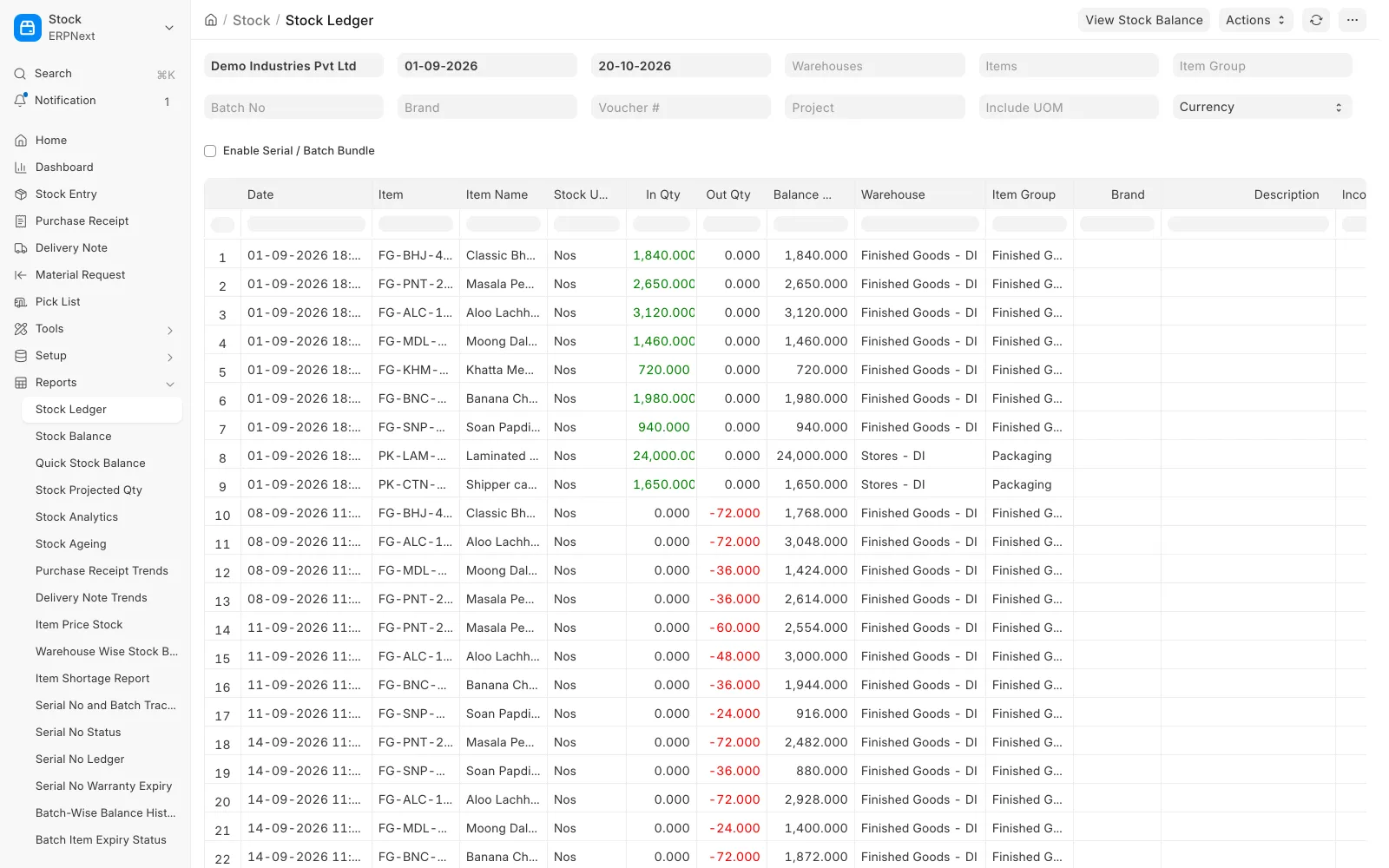
- Material you send to a job worker is tracked against the order and used up when the receipt is made, so you can see what each job worker still holds.
- Batch and serial numbers
- You switch these on item by item. Batches can carry an expiry date and shelf life, and every stock movement records which batch or serial number moved.
- Quality inspection
- You can make inspection mandatory before a purchase receipt or before delivery, item by item, with readings recorded against a template.
- Landed cost
- A landed cost voucher adds freight, duty and clearing charges to the item's valuation, so they show up in your stock value and margin instead of sitting in an expense account.
Compliance
India compliance notes.
- Job work challans and ITC-04
- E-invoicing with IRN and QR code
- E-way bills from the invoice or delivery note
- GSTR-2B matching and GSTR-1
The detail on eachThresholds, returns and how we set each one up.
- Job work challans and ITC-04
- Goods you send to a job worker go out on a delivery challan and have to come back within the GST time limits. The subcontracting records give you the quantities for the ITC-04 return, and we confirm the exact filing steps with you during discovery.
- E-invoicing with IRN and QR code
- If your turnover is above the notified threshold, you need to issue e-invoices. The India Compliance app generates the IRN and signed QR code from the sales invoice through the NIC portal.
- E-way bills from the invoice or delivery note
- Most goods movements above Rs 50,000 in consignment value need an e-way bill. India Compliance generates it from the sales invoice or delivery note, with the transporter and vehicle details filled in.
- GSTR-2B matching and GSTR-1
- The input tax credit you can claim depends on what your suppliers file. India Compliance matches your purchase invoices against GSTR-2B and GSTR-2A, and it prepares your GSTR-1.
Engagement
How a project with us runs.
01
A call
30 minutes, no charge
02
Discovery
1 to 2 weeks, paid
03
Blueprint
Included in discovery
04
Build
3 to 8 weeks
05
Acceptance
1 to 2 weeks
06
Go-live and run
Ongoing
We explain the full method, and why we charge for discovery, on the services page.
Evidence
Our work in this sector.
No case study yet
We haven't published a manufacturing case study yet, so the problems and features above come from how we scope a plant and what ERPNext does, rather than from a past client.
So far we've published case studies in Education and IT services. You can read all of them on the work page.
Questions buyers actually ask.
Yes. Subcontracting orders and receipts track the material you send to a job worker and what comes back, and the challans and the stock held at each job worker come from those same records.
ERPNext's BOM, work order and job card setup is built for discrete manufacturing, though it does handle process loss and scrap on the BOM. If you run a continuous process plant, we'd want to look at it closely in discovery before promising it fits.
Discovery takes one to two weeks. The build usually runs three to eight weeks, then one to two weeks of acceptance testing on your real process.
Not on day one. Some plants keep their accounts in Tally while production moves to ERPNext, and move the ledger across later. We plan when that switch happens as part of the blueprint.
Yes, job cards and stock entries work in the phone's browser. We keep shop floor forms short, because nobody fills in a long form on a phone.
Services for this sector.
- ERPNext implementationAccounts, stock, buying, selling and manufacturing, with your setup kept in code.
- ERP discovery and blueprintA paid, signed requirements document you can take to any implementer.
- Tally to ERPNext migrationWe move your masters, opening balances and open documents across, then reconcile them.
- Frappe HR and payrollIndian payroll with PF, ESI, PT and TDS, checked against figures worked out by hand.
Let's start with a call.
Thirty minutes, free of charge, and you won't sit through a sales deck.